CUHK-Shenzhen Student Helps sZs Win the ICRA 2026 LeHome Challenge Real-World Final
A CUHK-Shenzhen SDS master's student and 2024 alumnus, Guo Shuqi, was a core member of team sZs, which ranked first in the ICRA 2026 LeHome Challenge real-world final.
本文为媒体报道导读与转载整理。完整原文请访问原媒体页面;本站补充研究脉络、项目入口与 FreedomAI Lab 相关说明。
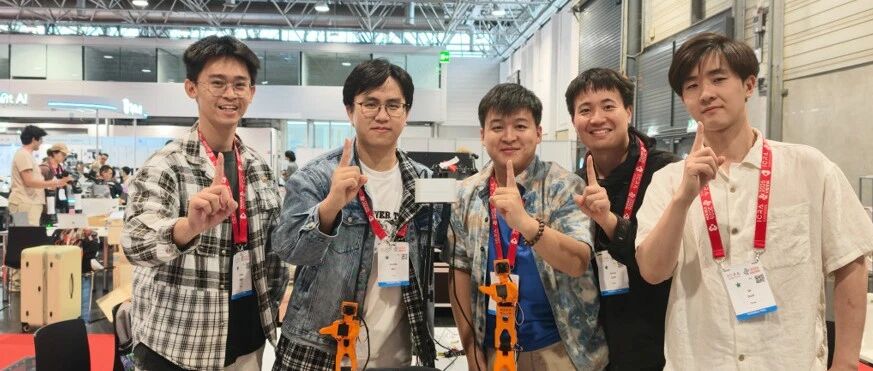
The CUHK-Shenzhen School of Data Science WeChat account recently reported that team sZs ranked first in the ICRA 2026 LeHome Challenge real-world final, earning a score of 895. A core member of the team is Guo Shuqi, a CUHK-Shenzhen master’s student in the School of Data Science, Shaw College member, and 2024 undergraduate alumnus.
The result is more than a competition headline. LeHome is a robotics challenge about teaching robots to manipulate garments, one of the most stubborn everyday tasks for embodied intelligence. Folding, unfolding, grasping, moving, and reorganizing clothes require a robot to reason about deformable objects whose shapes change continuously under contact.
Quick Read

What Is the LeHome Challenge?
The LeHome Challenge 2026 was an official ICRA 2026 competition on garment manipulation skill learning in household scenarios. The official ICRA competition page describes garment manipulation as a difficult robotics problem because it involves deformable objects and contact-rich interaction. The LeHome organizers frame the challenge as a standardized benchmark for evaluating whether robots can understand and manipulate garments effectively.
The official challenge website describes a two-phase format. The first phase was an online simulation challenge running from early 2026 through April, and the second phase was a real-world challenge held on-site at ICRA in Vienna. Top teams from simulation were invited to the real-world stage, where the system had to survive the gap between a controlled virtual environment and real physical hardware.
Why Garment Manipulation Is Hard
Many robotic manipulation benchmarks focus on rigid objects: blocks, tools, boxes, or parts whose geometry can be modeled with relatively stable assumptions. Garments are different. A shirt or pair of pants can fold, twist, wrinkle, occlude itself, and change shape after every grasp.
That makes the task a compact test of embodied intelligence. A useful system needs perception to infer garment state, policy learning to choose actions, control to execute those actions, and verification to decide whether the task is actually progressing. A robot also has to recover from failures, because small physical errors can compound across a long-horizon folding sequence.
The LeHome simulation paper makes this point from the infrastructure side: household robotics needs environments that support deformable objects, realistic interactions, varied categories, and practical robot embodiments. In other words, the field needs benchmarks that look less like isolated pick-and-place demos and more like everyday work.
From Simulation to Real Robots
The LeHome organizers designated the LeRobot SO-ARM101 as the robotic arm for both simulation and real-world phases. This matters because it forces teams to think about sim-to-real transfer rather than treating simulation as an isolated leaderboard game.
The challenge GitHub repository also emphasizes an important evaluation detail: garments from different categories are loaded randomly, and participants cannot rely on ground-truth category labels during evaluation. A successful policy therefore has to infer what it is facing and choose actions robustly under uncertainty.
That is why the sZs result is technically meaningful. According to the SDS announcement, the team integrated algorithmic models, visual perception, control strategies, and real-machine deployment into a complete loop. This is precisely where robotics becomes engineering: not just training a policy, but making the system work under timing pressure, camera noise, physical variability, and on-site constraints.
Why This Win Matters
For CUHK-Shenzhen, the win highlights the value of cross-disciplinary training. Guo Shuqi’s work sits at the intersection of vision-language-action models, embodied intelligence, human-robot interaction, and real-world system reliability. The SDS announcement notes that he is advised by Prof. Benyou Wang and Prof. Bingyi Jing, and that his broader research asks how AI systems can move from understanding to reliable action.
For the broader robotics community, LeHome points toward a healthier style of benchmark. The field is moving beyond short demonstrations toward tasks that require long-horizon execution, physical grounding, and repeatable evaluation. A garment-folding robot may sound domestic, but the underlying problem is general: how can an AI system perceive a changing physical state, plan under uncertainty, act through imperfect hardware, and verify its own progress?
That is also why this result belongs on the FreedomAI blog. It connects embodied AI to the lab’s wider interest in agents, interaction, evaluation, and real-world deployment. The future of AI will not only be models that answer questions. It will be systems that can close the loop between perception, reasoning, action, and verification.