AI Education
LLM agents as tutors, learners, user simulators, and standardized patients for scalable, feedback-rich education.
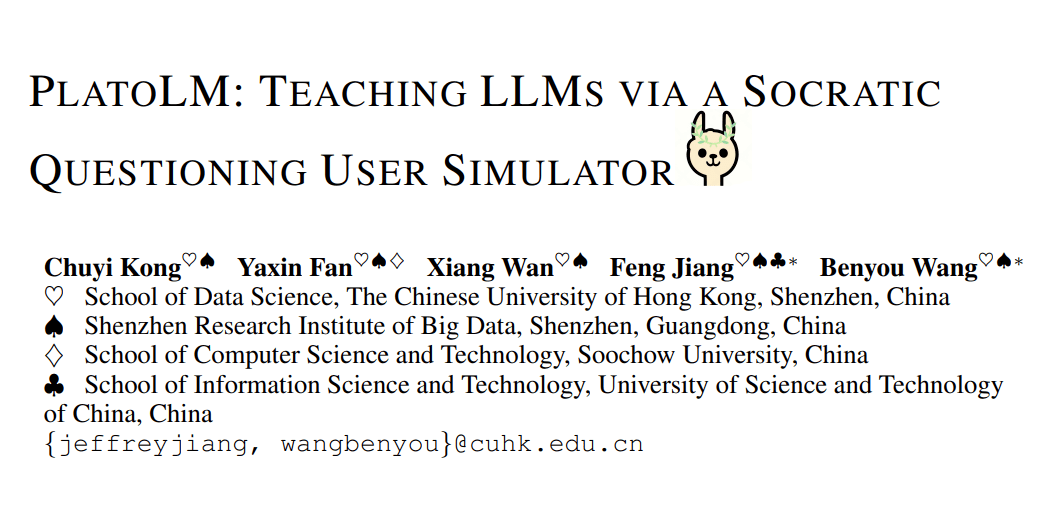
AI Education studies how LLM agents can become scalable tutors, learners, simulators, and standardized patients. The focus is educational interaction: models should ask useful questions, provide learner-aware feedback, support repeated practice, and make learning outcomes easier to evaluate.
Background and Motivation
A strong educational model should probe understanding, adapt to learners, guide reflection, and create practice loops rather than only deliver final responses.
Teachers, tutors, and standardized patients are difficult to scale across repeated sessions, diverse cases, and individualized feedback needs.
Educational AI should be judged by whether it improves question asking, self-regulation, communication, reasoning, and confidence under realistic interaction.
Research Storyline
User simulators create controllable multi-turn partners that can teach dialogue models, stress-test systems, and generate richer learning signals.
PlatoLM and Socratic-style data construction turn questioning, clarification, and guided reasoning into a training signal for multi-round dialogue.
SRLAgent explores how LLM assistance and gamified feedback can help learners plan, monitor, and reflect on their own study process.
EasyMED and SPBench make clinical communication training repeatable, controllable, and measurable for medical learners.
Representative Work
Builds an LLM-assisted learning system around planning, monitoring, reflection, feedback, and engagement.
PaperFrames LLMs as simulated users for interactive dialogue training and evaluation.
PaperUses Socratic-style questioning to improve multi-turn dialogue learning.
PaperIntroduces EasyMED and SPBench for comparing AI standardized patients with human standardized patients in medical education.
PaperStudies how medical learners experience AI standardized patients and what design requirements emerge from real use.
PaperProject Clusters
LLM systems that scaffold planning, reflection, formative feedback, and learner engagement.
Question-driven user simulation and data construction for teaching models to handle multi-round educational dialogue.
AI standardized patients for history taking, communication, empathy, diagnostic reasoning, and structured feedback.
Benchmarks and rubrics that connect interaction quality to measurable learning behavior and outcomes.
Display Figures
Resource Map
Open resources for Socratic-style dialogue training and user-simulator-driven model improvement.
RepositoryDataset resource behind Socratic dialogue construction and educational multi-turn training.
DatasetAI standardized patient framework and medical education evaluation resources.
Repository