China-Developed AI Computing: Adaptation and Acceleration
Large-scale Ascend training, full-stack acceleration, benchmark validation, real-world delivery, and open ecosystem building.
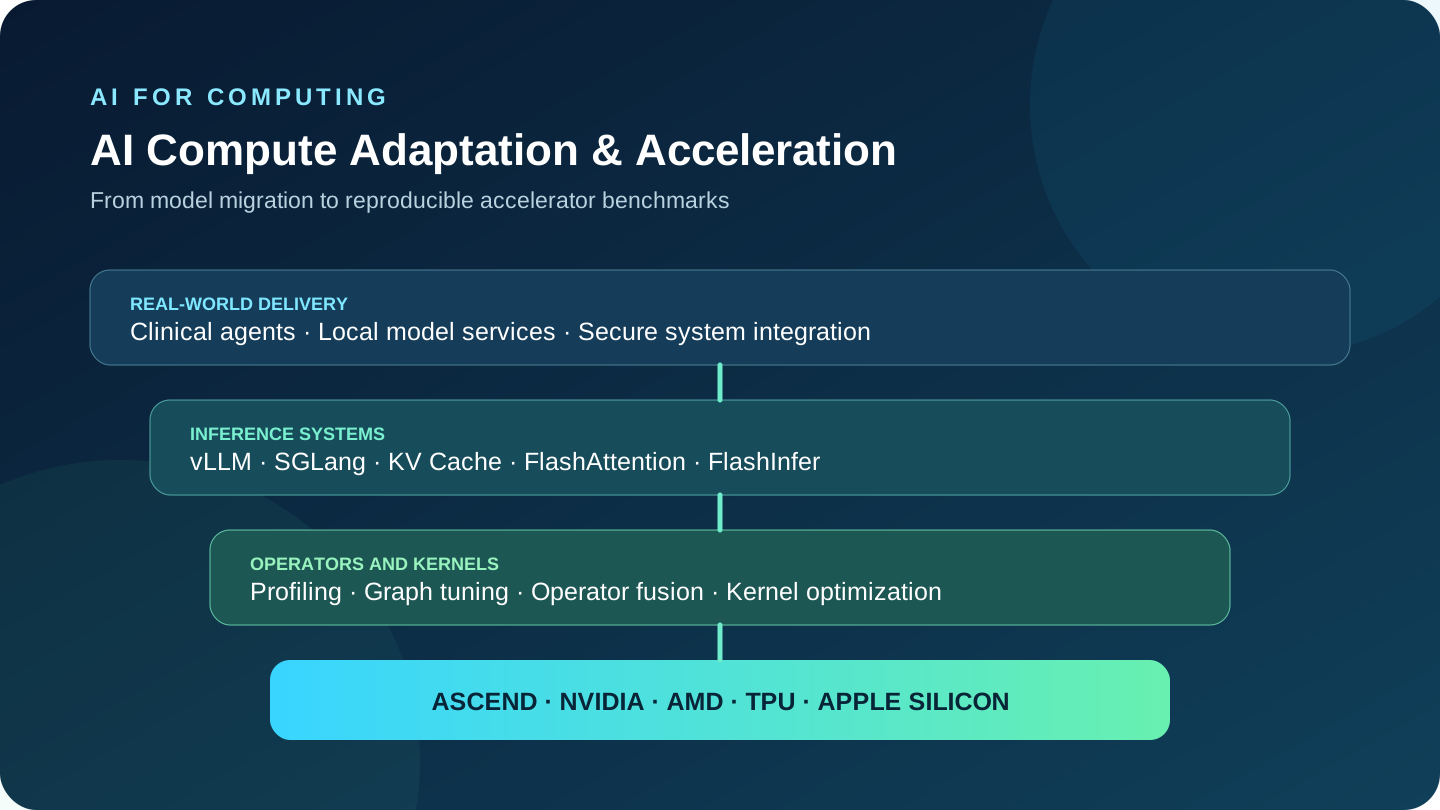
Our goal is not only to make large models run on China-developed AI accelerators, but to make them efficient, reliable, and scalable. The team has built an end-to-end technical chain connecting large-scale Ascend training, model and framework adaptation, inference acceleration, operator and kernel optimization, benchmark validation, real-world delivery, and open ecosystem development.
1. Large-Scale Training on Ascend
The team has first-hand experience training large language models on thousands of China-developed AI processors. In collaboration with Peng Cheng Laboratory and other institutions, the AraLLaMA/AceGPT-v1.5 program trained 7B and 13B Arabic models using 2,368 Huawei Ascend 910A processors, covering continual pre-training, progressive vocabulary expansion, and model alignment.
Arabic continual pre-training, supervised fine-tuning, and culturally grounded RLAIF established the localized LLM program.
NAACL 2024The 7B and 13B models were trained with 2,368 Ascend 910A processors, demonstrating large-scale training on China-developed AI compute.
ACL 2025Moves value alignment directly into pre-training rather than treating it only as a post-training step.
NeurIPS 20242. Full-Stack Compute Optimization
The capability has evolved from using China-developed compute to systematically optimizing it. Optimization spans the model, serving system, inference framework, operator, and kernel layers.
Compress system prompts and manage or compress KV Cache to reduce memory pressure and repeated computation.
Adapt and optimize vLLM, SGLang, FlashAttention, and FlashInfer-style components for target workloads and hardware stacks.
Profile bottlenecks and improve CANN operators, kernels, memory movement, graph execution, and hardware utilization.
Measure latency, throughput, concurrency, utilization, reliability, security, and deployment cost—not compatibility alone.
3. Benchmark Validation and Open Evaluation
Team solutions have taken top positions in multiple Ascend operator-optimization tasks. Because the leaderboard changes over time, each external claim should include a query date or archived screenshot.
BenchmarkAn open, community-driven benchmark for LLM inference across NVIDIA, AMD, Ascend, Apple Silicon, TPU, and emerging accelerators.
Open benchmarkResults connect performance with environment metadata, runner versions, execution outputs, and reproduction instructions.
AccelMark aims to compare hardware together with vLLM/SGLang, KV Cache methods, FlashAttention/FlashInfer, operators, and kernels under a shared experimental framework.
4. Hospital and Industry Delivery
Real applications turn optimization into measurable engineering requirements. Hospital workflows expose concrete constraints for privacy, latency, concurrency, reliability, and deployment cost; these requirements feed back into system optimization and hardware adaptation.
The team supported localized deployment at The Chinese University of Hong Kong, Shenzhen Hospital. Read-only access to hospital information systems helps preserve medical-data and system integrity.
Hospital reportThe system supports customized screening-package recommendations and uses idle nighttime compute to process examination records in batches, generating reports and personalized follow-up guidance.
The team collaborates with companies including KernelCAT developer Zhizi Xinyuan on model migration, framework tuning, inference acceleration, and operator optimization across CUDA and CANN stacks.
KernelCATSecurity, latency, throughput, concurrency, reliability, and cost become concrete targets.
Models, runtimes, caches, operators, and kernels are tuned against production workloads.
Methods are ported, measured, and validated across China-developed and heterogeneous accelerator stacks.
5. Open Models, Data, and Community Infrastructure
The long-term objective is to turn project experience into reusable community infrastructure. Open benchmarks, models, datasets, serving recipes, and kernel knowledge reduce repeated adaptation work across a fragmented accelerator ecosystem.
FreedomIntelligence hosts more than one hundred public model repositories spanning HuatuoGPT, AceGPT, ShizhenGPT, openPangu, and related releases.
Hugging FaceopenPangu-Embedded-7B was trained from scratch on Ascend NPUs with approximately 19 trillion tokens.
Model cardPeriodic team statistics report more than one million cumulative downloads and a peak above 200,000 downloads for one model in one month. Rolling figures should be published with dates and archived evidence.
OrganizationHugging Face TRL uses FreedomIntelligence/medical-o1-reasoning-SFT as an example for preprocessing a non-standard dataset format.
SFTTrainer documentationRepresentative FreedomIntelligence repositories have collectively received more than ten thousand publicly visible Stars.
GitHub organizationEvidence and Resources
AceGPT at NAACL 2024, Progressive Vocabulary Expansion at ACL 2025, and Native Alignment at NeurIPS 2024.
AceGPT · ACL 2025 · NeurIPS 2024Official report on localized OpenClaw, HuatuoGPT, read-only access, and health-screening workflows.
CUHK-Shenzhen MedicineFreedomIntelligence on Hugging Face and GitHub, openPangu-Embedded-7B, and TRL documentation.
Hugging Face · openPangu · TRL · GitHubFrom Available to Efficient and Scalable
The capability path is clear: train models on thousands of China-developed processors; optimize the full software stack; validate performance through benchmarks; solve real hospital and industry problems; and convert the resulting knowledge into open benchmarks, models, and community infrastructure.