Economic World Models
Building AI-system blueprints for agentic economies, policy sandboxes, and self-correcting economic twins.
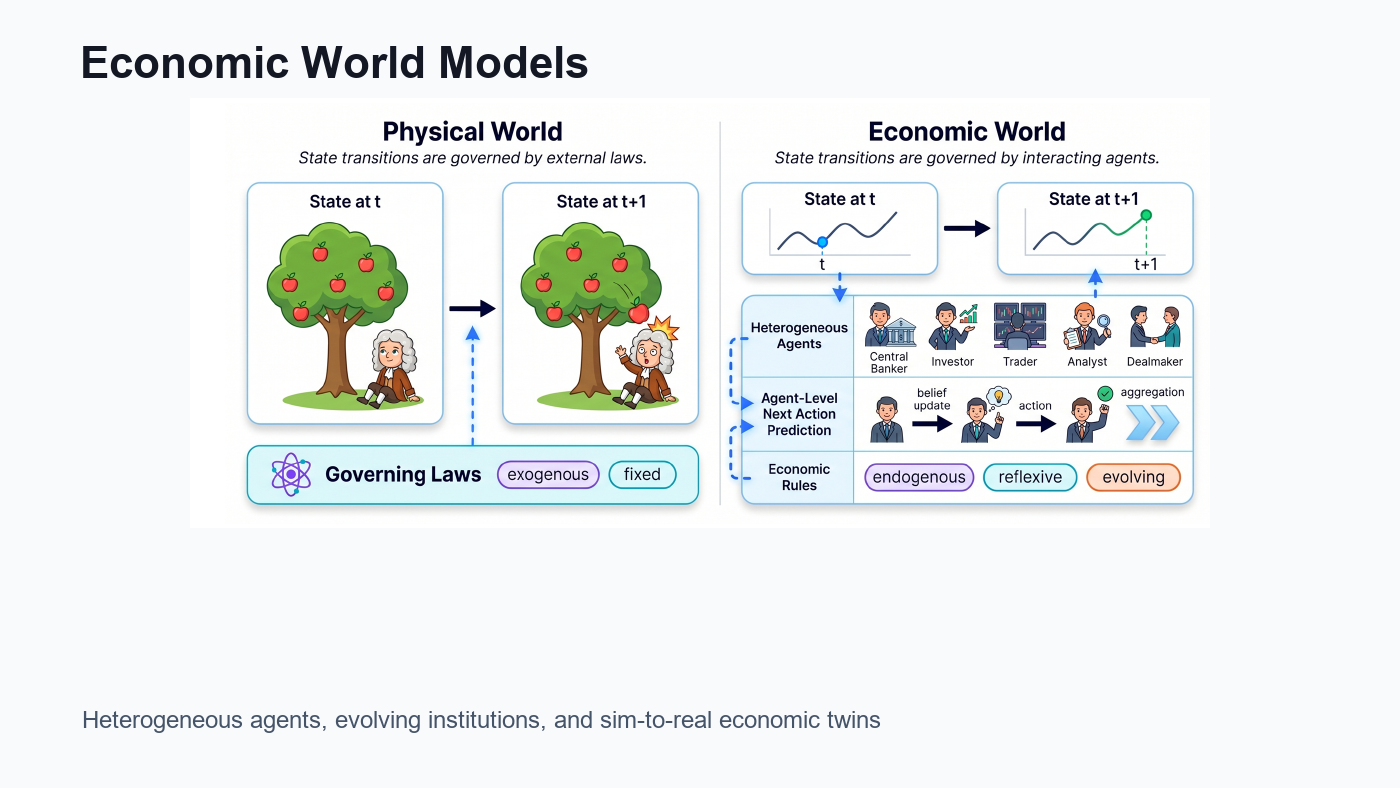
Economic decisions are usually made in the real world first and evaluated afterward. Economic World Models invert that workflow: they ask how we can build computable economies where heterogeneous agents observe, reason, act, interact, adapt, and co-evolve with markets and institutions before policies, strategies, or AI agents are deployed at scale.
The project develops an implementation-oriented systems blueprint for EconWM systems. It connects economic discipline with AI-system design, treating an economy as a generative engine whose state transitions are produced from inside the modeled world. Agents form beliefs, choose actions, alter the aggregate state, and then respond to the world they helped create.
What The Project Builds
Simulation environments where households, firms, banks, investors, regulators, and AI agents can interact under explicit objectives, constraints, information, and rules.
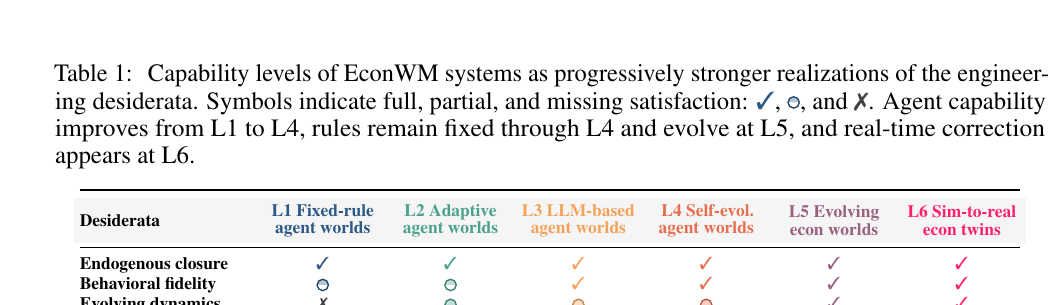
A taxonomy from fixed rule-based agent worlds to adaptive agents, LLM-based autonomous agents, self-evolving agents, evolving institutions, and sim-to-real economic twins.
Mechanisms for comparing simulated outcomes with real economic evidence, diagnosing deviations, and correcting agents, mechanisms, and transition dynamics over time.
Systems Blueprint
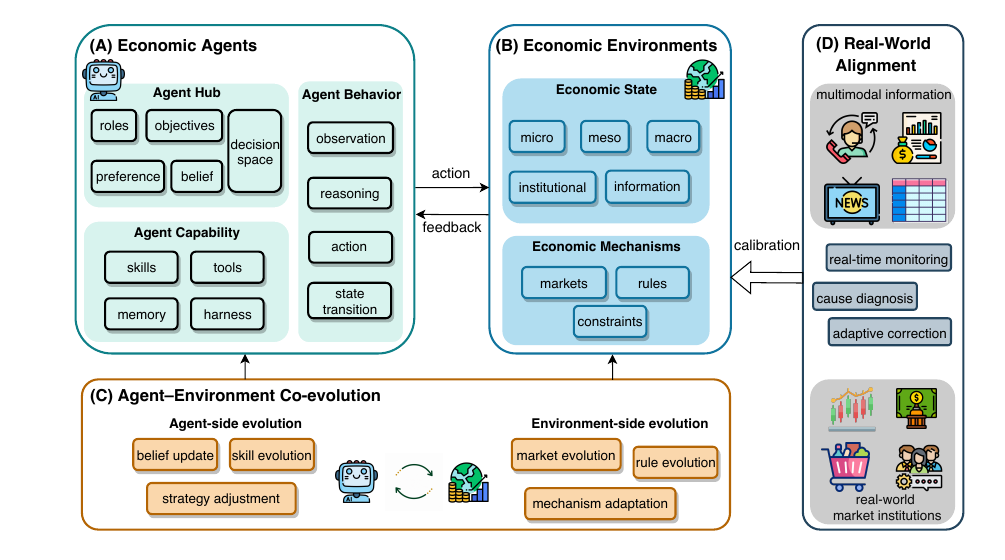
The proposed EconWM architecture has four connected layers: economic agents, economic environments, agent-environment co-evolution, and real-world alignment. This makes the project more than a survey of AI agents in economics: it is a build plan for economic digital twins that can reason, simulate, learn, and stay empirically grounded.
Research Team
The work brings together researchers across Shenzhen Loop Area Institute, CUHK-Shenzhen School of Data Science, the University of Hong Kong, and Nanyang Technological University.





Selected Publications
Jiale Han, Xiang Li, Jing Qian, Wenyuan Gu, Pin Gao, Ye Luo, Hongyuan Zha, Dacheng Tao, Benyou Wang, and Lin William Cong. Working Paper.
PaperYuzhe Yang, Yifei Zhang, Minghao Wu, Kaidi Zhang, Yunmiao Zhang, Honghai Yu, Yan Hu, and Benyou Wang. NeurIPS 2025; Best Paper, ICLR 2025 Financial AI Workshop.
PaperYuzhe Yang, Yifei Zhang, Yan Hu, Yilin Guo, Ruoli Gan, Yueru He, Mingcong Lei, Xiao Zhang, Haining Wang, Qianqian Xie, Jimin Huang, Honghai Yu, and Benyou Wang. Findings of NAACL 2025.
PaperQianqian Xie, Weiguang Han, Zhengyu Chen, Ruoyu Xiang, Xiao Zhang, Yueru He, Mengxi Xiao, Dong Li, Yongfu Dai, Duanyu Feng, Yijing Xu, Haoqiang Kang, Ziyan Kuang, Chenhan Yuan, Kailai Yang, Zheheng Luo, Tianlin Zhang, Zhiwei Liu, Guojun Xiong, Zhiyang Deng, Yuechen Jiang, Zhiyuan Yao, Haohang Li, Yangyang Yu, Gang Hu, Huang Jiajia, Xiaoyang Liu, Alejandro Lopez-Lira, Benyou Wang, Yanzhao Lai, Hao Wang, Min Peng, Sophia Ananiadou, and Jimin Huang.
PaperJimin Huang, Mengxi Xiao, Dong Li, Zihao Jiang, Yuzhe Yang, Yifei Zhang, Lingfei Qian, Yan Wang, Xueqing Peng, Yang Ren, Ruoyu Xiang, Zhengyu Chen, Xiao Zhang, Yueru He, Weiguang Han, Shunian Chen, Lihang Shen, Daniel Kim, Yangyang Yu, Yupeng Cao, Zhiyang Deng, Haohang Li, Duanyu Feng, Yongfu Dai, VijayaSai Somasundaram, Peng Lu, Guojun Xiong, Zhiwei Liu, Zheheng Luo, Zhiyuan Yao, Ruey-Ling Weng, Meikang Qiu, Kaleb E Smith, Honghai Yu, Yanzhao Lai, Min Peng, Jian-Yun Nie, Jordan W Suchow, Xiao-Yang Liu, Benyou Wang, Alejandro Lopez-Lira, Qianqian Xie, Sophia Ananiadou, and Junichi Tsujii.
PaperGang Hu, Ke Qin, Chenhan Yuan, Min Peng, Alejandro Lopez-Lira, Benyou Wang, Sophia Ananiadou, Jimin Huang, and Qianqian Xie.
PaperFrom Papers to Systems
The Economic World Models page is the umbrella. Under it, TwinMarket provides a concrete financial market sandbox, MicroVerse explores scientific micro-world simulation, and the curated Awesome Econ World Models repository keeps the paper trail organized. Together they turn the idea of "agents in an environment" into a program about evolving worlds: social worlds, market worlds, biological worlds, and eventually policy-facing digital twins.
Financial agent society where LLM investors create market-level behavior from individual beliefs, desires, intentions, and information flow.
MicroVerseScientific micro-world simulation for biological processes where hidden mechanisms and state transitions matter as much as visual appearance.
Awesome Econ World ModelsLiving bibliography and implementation map for economic agents, agentic economies, institutional evolution, and sim-to-real alignment.